
AI Hackathon 2026
Global Hackathon
Using AI for Digital Trade
Regulatory Analysis






And World Trade Organization (WTO)
Contact us: escap-digitaltrade-hackathon@un.org and regtech2026@kmitl.ac.th
Watch Our Introduction
Learn more about the hackathon and how you can make a global impact.
About the Initiative
AI for Digital Trade Regulatory Analysis
A United Nations initiative to support intelligent, transparent, and evidence-based digital governance.
This initiative is powered by the United Nations and a world-wide partnership with leading universities and international organizations. Anchored by UNESCAP, and with KMITL serving as the operational hub, the initiative is supported by globally renowned institutions that contribute academic rigor, policy expertise, and technical excellence.
Why It Matters
Navigating digital trade and data regulations is complex. AI offers the opportunity to streamline legal discovery, enhance consistency, and make regulatory information truly accessible.
What Is It About
This global challenge invites teams to design AI‑powered tools that can discover, extract, and map digital trade regulations. The solutions that can become open-source (Apache 2.0), scale across countries, languages, and adapt to diverse environments win.
How It Works
Teams submit initial proposals. Shortlisted teams advance to further development rounds, culminating in a final onsite showcase where finalists demonstrate their tools to an international panel.
What Participants Can Expect
Participants gain hands‑on experience with cutting‑edge, practical techniques and guidance from global experts. By joining, teams enter a unique ecosystem where policymaking expertise meets technological innovation. Selected teams are awarded certificates and capacity-building opportunities.
THE CHALLENGE
REGULATORY & TECHNICAL SCOPE
1. REGULATORY SCOPE
Your system will work with real laws and regulations from different countries and map them to a given framework. Participants do not need prior knowledge of specific frameworks. The reference framework will be provided during the competition.
Mandatory Areas (Minimum requirements)
Your tool must be able to identify and analyze regulations related to:
- Cross-border data flows (rules about how data moves between countries)
- Domestic data protection (rules about how personal or sensitive data is handled within a country)
Optional Areas (Bonus Points)
Tools that can expand to more areas will demonstrate stronger capability and earn additional credit.
2. TECHNICAL SCOPE
Your tool must complete both required tasks:
Automated Evidence Discovery
Your system must be able to find and read real legal documents on its own:
- Navigate official government websites or legal portals
- Retrieve relevant laws and regulations, including scanned or image-based files
- Detect potentially relevant documents using keywords or semantic cues
- Extract text with good accuracy and preserve document structure
Intelligent Mapping & Verification
After retrieving documents, your system must pinpoint, classify, and verify the relevant evidence clearly and transparently:
- Identify specific clauses related to the assigned regulatory categories
- Provide precise citations (article, section, paragraph)
- Display a side-by-side audit view showing the extracted text next to the original source
- Handle documents from different countries and languages consistently
Hackathon Timeline
Timeline: Now to Finale
You have 7 weeks to build a working engine. Here is every key date.
Substantive Workshops
Technical Workshops
Submission Deadline
20 Teams Shortlisted
Live Pitch (20 Teams)
5 Finalists Announced
Grand Finale
Substantive Workshops
Technical Workshops
Submission Deadline
20 Teams Shortlisted
Live Pitch (20 Teams)
5 Finalists Announced
Grand Finale
Key dates
1–5 Jun: Substantive Workshops — RDTII framework, legal text decoding
11–15 Jun: Technical Workshops — RAG, OCR stack, responsible AI
20 Jul: Submission Deadline — 40+ teams submit
31 Jul: 20 Teams Shortlisted — Announced from 40+
3 Aug: Live Pitch (20 Teams) — Online pitching session
5 Aug: 5 Finalists Announced — Advance to Bangkok finale
Oct 2026: Grand Finale — Bangkok award ceremony
Focus of Competition
Focus of Competition
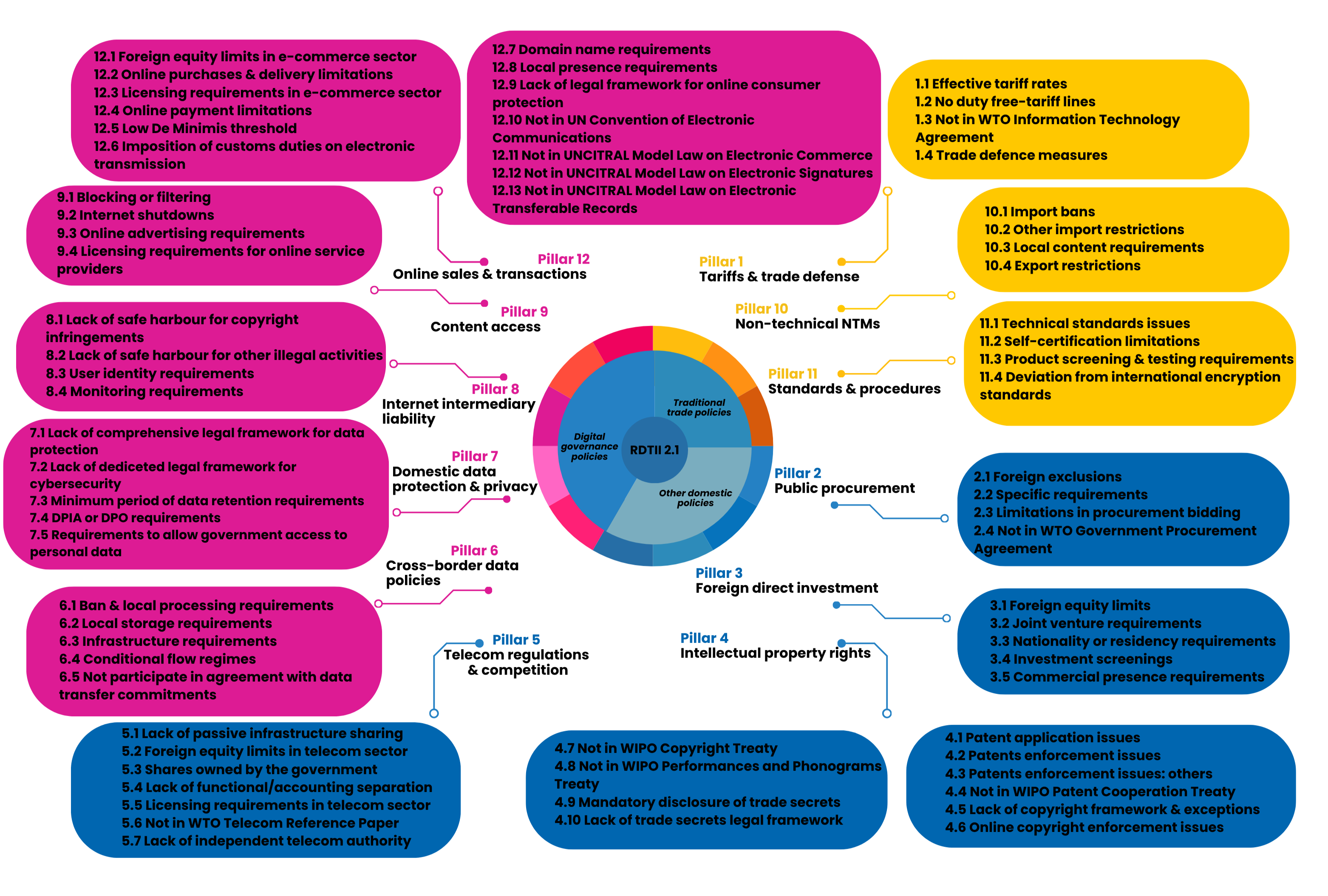
The competition focuses on developing an intelligent system that can automatically extract legal text and map regulatory evidence using the Regional Digital Trade Integration Index (RDTII) framework of the UN—at minimum focusing on Pillar 6 and Pillar 7. The RDTII provides a comparable structure for assessing digital trade regulations.
- Pillar 6: Cross-Border Data Policies (data localization, processing requirements, conditional flow regimes)
- Pillar 7: Domestic Data Protection & Privacy (legal frameworks, data retention, compliance obligations)
Incentives
What's at Stake
Beyond the Prize Money
An opportunity to make real impact. Your work may become part of the future of evidence-based digital governance. Your solutions may support governments, researchers, and development organizations across developing economies.
Shortlisted teams
PROFESSIONAL RECOGNITION
- •Certificate of Achievement from the United Nations
- •Endorsement of competencies demonstrated during the competition
- •Opportunities to be highlighted in UN platforms and partner events
- •Open long-term collaboration pathways with innovators, experts, academics, and international organizations
Shortlisted teams
CAPACITY BUILDING
An opportunity to interact with experts in AI, digital governance, and international trade policy.
- •Expert-led technical AI and digital policy workshops
- •Hands-on feedback at key milestones
- •A curated resource library for technical and substantive learning
Top 5 Teams
TRAVEL GRANTS
Funding for five finalist teams to present their final solutions in Bangkok.
- •Travel grant based on actual costs, up to 4000 USD per team
TOP-3 Teams
1,500 USD per team
1st Runner-Up
2,000 USD per team
1,000 USD per team
2nd Runner-Up
Anyone Can Participate
Where Code Meets Law
Teams must have technical and policy/legal skill sets.
1 Technical Lead
AI, data extraction, or software development
1 Substantive Lead
Law, policy, or regulatory analysis
Team of up to 5 members (including leads)
Solo participant must have capability in both technical and substantive areas
How to Apply
Global Call for Applications
Application deadline in:
STAGE 1: APPLICATION
1. Team Profiles
CVs or short bios of all team members, highlighting relevant skills and experience.
2. Concept Video
(5 minutes)
A simple, clear video explaining your strategy for Automated discovery of legal documents and Mapping and verification of regulatory evidence.
3. Technical Memo
(max 2 pages)
A brief outline of:
- 1. Proposed system architecture
- 2. Tools, models, and methods you plan to use
- 3. How you will ensure accuracy, transparency, and cost-efficiency
4. Signed Declaration
Conforming originality and open source consent. Minor (under 18) must provide guardian consent and co-signature.
STAGE 2: PROTOTYPE ROUND
Shortlisted teams: Develop a working prototype using sample laws and submit the following
Prototype (Alpha)
A backend engine performing discovery, extraction, mapping, and categorization on sample legal documents.
Output Sample
Machine-readable files with indicator mapping, exact citations, verbatim snippets, and discovery tags.
Technical Pitch Deck
A presentation explaining your problem-solution fit, backend logic, and approach to both tasks.
Demo Walkthrough (10 minutes)
A screen-recorded run-through showing your engine processing a complex document with correct citations.
STAGE 3: FINALE
Finalists: Develop a scalable solution and submit the following
Full Open-Source Codebase
Documented, reproducible code under Apache 2.0, including README and environment setup.
Technical Documentation
Description of extraction/mapping logic, plus instructions for swapping to self-hosted/open-weight models where applicable.
User Interface
Side-by-side evidence viewer and one-click export.
Final Presentation
A live demo and interview.
Contact us: escap-digitaltrade-hackathon@un.org and regtech2026@kmitl.ac.th
FAQ
Frequently Asked Questions
DISCLAIMER
This Hackathon does not constitute an endorsement or promotion of any commercial products, services, applications, or ICT-based solutions developed or used by participants. Furthermore, nothing within this activity should be construed as a recommendation for governments to procure ICT products or services that do not comply with their respective national laws and regulations.
TERMS AND CONDITIONS
- Participants grant the UN (including ESCAP) a perpetual, worldwide license to use, modify, reproduce, and distributed submissions for non-profit, developmental, and global-public-good purposes.
- All codes, documents, and outputs must be released as open source under the Apache License 2.0.
- Submissions must not infringe any third party's rights. Participants are fully responsible for ensuring proper licensing, attribution, and legality of all components used. The UN is not liable for any third-party IP claims related to participant submission.
- Participant grants the UN to use their image, name, and voice to promote the hackathon, at no cost.